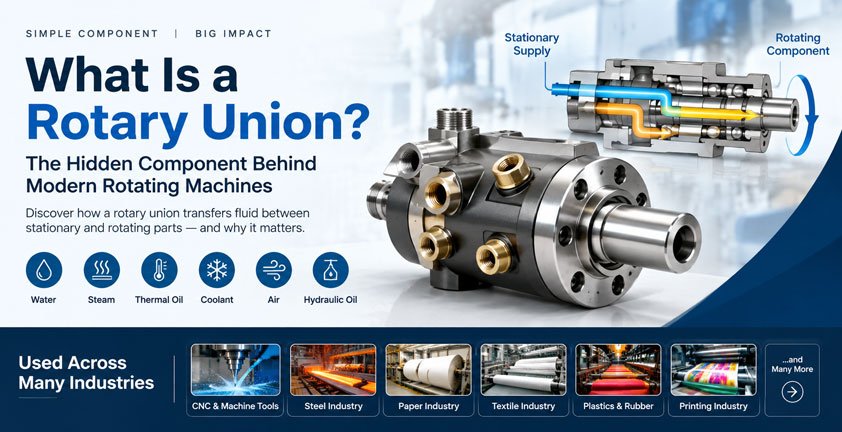
Have you ever wondered how a machine can continuously transfer water, coolant, steam, oil, air, or other fluids to a rotating component without stopping its movement?
The answer is a rotary union.
A rotary union is a precision mechanical device designed to transfer fluid or media between a stationary supply system and a rotating machine component while allowing continuous rotation. It is widely used in machine tools, steel plants, paper machines, textile machinery, plastics and rubber equipment, printing machines, and many other industrial applications.
What Is a Rotary Union?
Have you ever wondered how a machine can continuously transfer water, coolant, steam, oil, air, or other fluids to a rotating component without stopping its movement?
The answer is a rotary union.
A rotary union is a precision mechanical device designed to transfer fluid or media between a stationary supply system and a rotating machine component while allowing continuous rotation. It is widely used in machine tools, steel plants, paper machines, textile machinery, plastics and rubber equipment, printing machines, and many other industrial applications.
How Does a Rotary Union Work?
The rotary union working principle is relatively simple, although the internal engineering can be highly precise.
A typical rotary union contains several important components, including:
- Housing
- Rotor
- Seals
- Bearings
- Internal fluid passages
- Connection ports
The rotor rotates with the machine, while the housing is connected to the stationary piping system. Bearings support smooth rotation, while seals control the fluid interface and help prevent leakage.
Step-by-step working principle
Step 1: Fluid enters the rotary union
A pump or other stationary source supplies the required fluid through the inlet connection.
Step 2: Fluid passes through the internal passage
The fluid travels through the rotary union’s internal passageway.
Step 3: The machine rotates
The rotor is connected to the rotating machine component and rotates along with it.
Step 4: Seals maintain the connection
The sealing system allows relative movement between stationary and rotating components while containing the fluid.
Step 5: Fluid reaches the rotating component
The fluid is continuously delivered to the rotating component for cooling, heating, lubrication, hydraulic actuation or another process requirement.
This arrangement allows fluid transfer without requiring the machine to stop.
What Are the Main Components of a Rotary Union?
Understanding the basic components helps when selecting or troubleshooting a rotary union.
1. Housing
The housing forms the main body of the rotary union and provides the connection to the stationary side of the system.
2. Rotor
The rotor is connected to the rotating machine component and provides the rotating fluid path.
3. Mechanical Seals
Seals are among the most important components because they control leakage at the interface between rotating and stationary parts.
The appropriate seal material and design depend on the application, media, pressure, temperature and rotational speed.
4. Bearings
Bearings support the rotating elements and help maintain smooth operation.
5. Internal Passages
The internal passages carry the fluid through the rotary union.
Some applications require only one passage, while others require multiple independent passages for different fluids.
What Are the Different Types of Rotary Unions?
There is no single rotary union that is suitable for every application.
The correct design depends on the media, pressure, temperature, RPM, number of passages, mounting arrangement and operating environment.
Common types include:
Single-Passage Rotary Union
A single-passage rotary union is designed for one fluid circuit.
It can be used for applications where only one medium needs to be transferred between the stationary and rotating components.
Dual-Passage Rotary Union
A dual-passage configuration provides two separate fluid paths.
For example, one passage can be used for fluid supply and another for return.
Multi-Passage Rotary Union
Multi-passage rotary unions are designed for applications requiring multiple independent fluid circuits.
They can be useful when a rotating assembly needs more than one medium or separate supply and return paths. Industry designs can include multiple independent passages, with the exact number depending on the manufacturer and application.
Water Rotary Union
Water rotary unions are commonly used for cooling or heating rotating equipment.
Applications include rollers, drums, machine components and industrial processing equipment.
Steam Rotary Union
Steam rotary unions are designed for applications where steam is used as a heating medium.
The seal, material and construction must be appropriate for the temperature, pressure and operating conditions.
Hot Oil / Thermal Oil Rotary Union
Thermal oil rotary unions are used where heated oil is circulated through rotating equipment.
They are commonly found in applications involving heated rollers, drying systems and process machinery.
Coolant Rotary Union
Coolant rotary unions are particularly important in machine tools and CNC applications.
They allow coolant to be transferred to rotating spindles or tooling systems during machining.
Hydraulic Rotary Union
Hydraulic rotary unions transfer hydraulic fluid between stationary and rotating components.
They are used where hydraulic pressure needs to be supplied to rotating machinery or mechanisms.
Where Are Rotary Unions Used?
Rotary unions are used wherever a machine needs to transfer fluid between stationary and rotating components.
Some important industries include:
CNC and Machine Tools
CNC machines may use rotary unions for coolant, cutting fluids, compressed air, MQL and other media.
High-speed spindle applications can require very precise rotary union designs because both rotational speed and pressure can be significant.
Steel Industry
Rotary unions are used in steel-processing equipment, including rolls and continuous casting systems, where cooling water may need to be transferred into and out of rotating components.
Paper Industry
Paper-processing machines use rotating rolls and cylinders where water, steam or thermal oil may be required for heating or cooling.
Textile Industry
Textile machinery can use rotary unions for heating, cooling and process-fluid circulation in rotating rollers and cylinders.
Rubber and Plastic Industry
Rotary unions are used in equipment such as calenders, rollers, mixers and other processing machinery.
Printing Machinery
Printing equipment may require temperature control of rotating rollers, making reliable fluid transfer important to the process.
Chemical and Pharmaceutical Equipment
Rotary unions can be used where controlled fluid transfer is required in rotating processing equipment.
Industry manufacturers list applications across machine tools, textiles, rubber and plastics, food and agriculture, chemical and pharmaceutical processing, metals, paper and cardboard, and energy.
Why Is a Rotary Union Important?
A rotary union may be a relatively small component, but its role can be critical.
A correctly selected rotary union can help a machine maintain continuous fluid transfer while the rotating component remains in operation.
Depending on the application, this can support:
- Continuous cooling
- Heating of rotating components
- Lubrication
- Hydraulic actuation
- Pneumatic functions
- Process-fluid circulation
- Temperature control
- Reduced fluid leakage
- Reliable machine operation
The importance of the rotary union increases when the machine operates at high speed, high pressure, high temperature or under continuous-duty conditions.
How Do You Select the Right Rotary Union?
Choosing a rotary union should not be based only on the connection size.
Several operating parameters should be considered.
1. Media
First identify exactly what will pass through the rotary union.
For example:
- Water
- Steam
- Coolant
- Hydraulic oil
- Thermal oil
- Air
- Vacuum
- Cutting fluid
Different media can require different seal materials and construction.
2. Operating Pressure
Determine the normal and maximum operating pressure.
A rotary union should be selected according to the actual application pressure and the manufacturer’s specified operating limits.
3. Rotational Speed
RPM is one of the most important selection parameters.
A rotary union designed for low-speed operation may not be suitable for a high-speed CNC spindle.
4. Temperature
The operating temperature of the media and surrounding environment must be considered.
Steam and thermal-oil applications, for example, have different temperature requirements from ordinary water applications.
5. Number of Passages
Determine whether the application needs:
- Single passage
- Supply and return
- Dual passage
- Multiple independent circuits
Multi-passage requirements can significantly affect the design and selection of the rotary union.
6. Connection and Mounting
Check:
- Thread type
- Port size
- Shaft dimensions
- Mounting arrangement
- Available installation space
- Radial or axial connection requirements
7. Material
The material should be compatible with the operating environment and media.
Stainless steel, for example, may be preferred in certain corrosive or hygienic applications.
8. Application Environment
Consider whether the rotary union will operate in:
- Dust
- Water
- Chemicals
- High temperature
- High vibration
- Continuous operation
- Contaminated industrial environments
These factors can influence the appropriate construction and sealing system.
Industry guidance commonly emphasizes physical dimensions, rotational speed, pressure, media, material and passage requirements when specifying a rotary union.