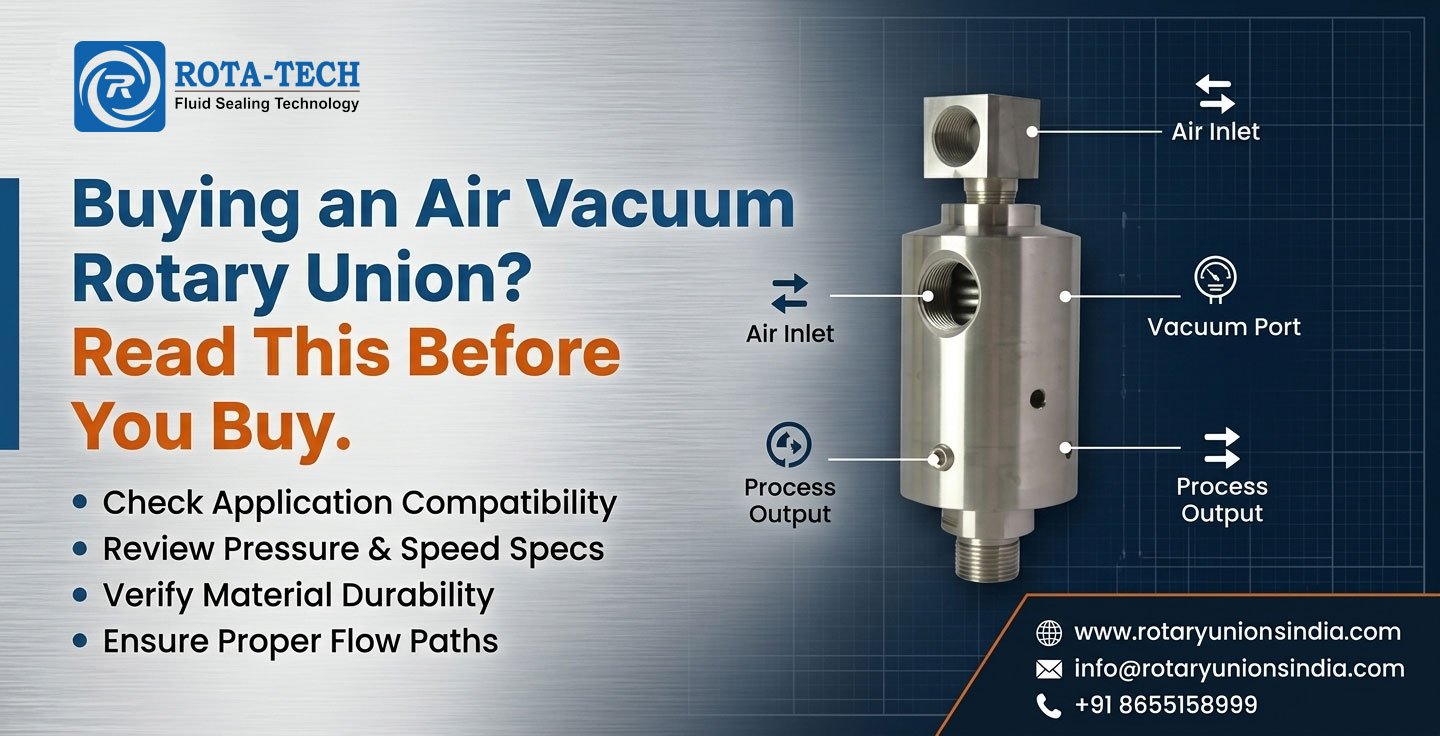
An air vacuum rotary union (also called a rotary joint) lets air or vacuum pass from a stationary line into a rotating part, such as a vacuum chuck, turntable or roller. To buy the right one, match it to your vacuum level, flow rate, rotation speed, seal type, material and port configuration. Picking by thread size alone is the most common and most expensive mistake.
Key takeaways
- Vacuum performance depends on the seal and flow path, not just port size.
- Higher RPM and a dry-air or vacuum medium need a seal designed for them.
- A union that leaks even slightly can cause weak holding force, longer cycle times and rejected parts.
- Always ask the supplier for leakage, speed and pressure ratings in writing.
What Is an Air Vacuum Rotary Union?
A rotary union connects a fixed pipe or hose to a rotating shaft. For vacuum applications, it must hold a seal while the shaft turns, so the vacuum doesn’t “bleed” in from outside air.
Common uses:
- Vacuum chucks and rotary tables
- Pick-and-place and handling machines
- Packaging, labeling and bottling lines
- Glass, panel and sheet handling
- Woodworking and CNC vacuum fixtures
- Semiconductor and wafer handling (high-precision, often high-vacuum)
9 Things to Check Before You Buy
1. Vacuum Level and Pressure Range
Check the minimum absolute pressure (or maximum vacuum, e.g. in mbar, Pa or -kPa) the union is rated for. A union for general-purpose suction (rough vacuum) is not suitable for high-vacuum processes. Also check the positive air pressure rating if the same line blows air.
2. Flow Rate and Port Size
A large thread does not guarantee good flow. Internal passages may be narrow, which causes vacuum drop at the load. Ask for the flow rate or Cv/conductance value and compare it with your pump capacity.
3. Seal Type
This is the heart of the union:
| Seal type | Best for | Watch out for |
|---|---|---|
| Carbon-graphite mechanical face seal | Dry air and vacuum, moderate speeds | Wear over time; needs clean media |
| Ceramic or hard-faced seals | Longer life, abrasive or demanding duty | Higher cost |
| Lip / elastomer seals | Low-speed, low-cost applications | Friction, heat and faster wear at high RPM |
| Ferrofluidic (magnetic fluid) seals | High vacuum, clean environments | Cost, temperature limits |
4. Rotation Speed (RPM)
Every union has a maximum speed. Running above it increases heat, friction and leakage. Give the supplier your continuous and peak RPM.
5. Number of Passages
Do you need one vacuum line, or vacuum plus air-blow-off, or multiple zones? A multi-passage union costs more but avoids stacking several units and saves space.
6. Materials
- Aluminum: light, economical, good for clean, dry applications.
- Brass: common and durable for general industrial use.
- Stainless steel (304/316): better corrosion resistance, washdown and food or pharma environments.
7. Mounting and Shaft Configuration
Check whether you need a shaft-mounted, flange-mounted or through-bore design. Confirm the shaft diameter, tolerances and concentricity. Misalignment is a leading cause of early seal failure.
8. Torque and Friction
Seals add rotational drag. For small motors, servo axes or precision indexing, this matters. Ask for the running torque figure.
9. Maintenance and Service Life
Ask:
- What is the expected life in rotations or hours under your conditions?
- Are seals replaceable, or is the whole unit disposable?
- Are spare parts and technical support easily available?
5 Common Buying Mistakes
- Choosing by thread size only. Match flow, not fittings.
- Ignoring the media. Dust, oil mist or moisture in the line shortens seal life. Add a filter or separator before the union.
- Letting hoses twist or pull the union. Use flexible, stress-free connections so the hose doesn’t transfer side load to the unit.
- Skipping speed and duty-cycle data. A union for occasional indexing is not built for continuous high-speed rotation.
- Buying purely on price. A cheap unit that leaks costs more in downtime, scrap and replacements.
Quick Selection Checklist
Send these details to your supplier for an accurate recommendation:
- Medium (air, vacuum, or both) and vacuum level required
- Flow rate or pump capacity
- Continuous and maximum RPM
- Operating temperature and environment (dust, moisture, washdown)
- Number of passages
- Shaft size, mounting style and space limits
- Expected duty cycle (hours per day)
- Required certifications or material standards
Troubleshooting: Is Your Rotary Union Failing?
| Symptom | Likely cause | Action |
|---|---|---|
| Weak holding force | Seal wear or leakage | Inspect or replace seal |
| Hissing sound | Air leak at the seal face | Check alignment and seal condition |
| Overheating | Speed too high or dry running beyond rating | Verify RPM and seal type |
| Vacuum drops at higher speed | Wrong seal or misalignment | Re-check specification |
Conclusion
The right air vacuum rotary union comes down to a few facts: your vacuum level, flow, speed, seal and environment. Share these with a knowledgeable supplier before you order, and you’ll save yourself leaks, downtime and rework.
Need help selecting one? Contact our technical team with your application details for a recommendation.